
Working draft for staging review — bracketed markers are open editorial items.
Pea Gravel vs. Crushed Rock: A Boise Valley Use-Case Guide (Patio, Driveway, Drainage & Cost)
By Tim Mussell — President & co-founder, Victory Greens Stone & Garden Center, Meridian, ID. 33 years selling and delivering stone across the Boise Valley.
For surfaces you compact or that carry weight — driveways, shed and paver bases, and French-drain trenches — choose crushed rock: its angular, jagged edges lock together and hold. For surfaces you walk, sit, play, or let pets run on — patios, pathways, dog runs, and playgrounds — choose pea gravel: its smooth, rounded stones are comfortable underfoot and won’t shift into hard edges. Neither material is universally “better”; the right pick is the one that matches the job — and in the Boise Valley both are sold by the cubic yard (1-yard minimum) and delivered.
There is no universally “better” gravel — pea gravel and crushed rock each win specific jobs, and choosing by the job beats choosing by looks or by price alone. Here’s how to pick by use case, what drives each one’s cost, and where to get it locally. First, two quick definitions.
Both are types of gravel — the umbrella term for the loose stone aggregate landscapers work with. Pea gravel is small, smooth, rounded stone — roughly 3/8″ across — named for its pea-like size and shape. Crushed rock (also called crushed stone) is larger rock that’s been mechanically crushed into angular, jagged pieces with sharp edges. That one difference — rounded versus angular — drives almost every verdict below: rounded stones stay comfortable and loose, while angular stones lock together and hold. It’s the same line the construction industry draws, distinguishing naturally occurring sand and gravel from crushed stone produced by mechanically crushing rock (U.S. Geological Survey).
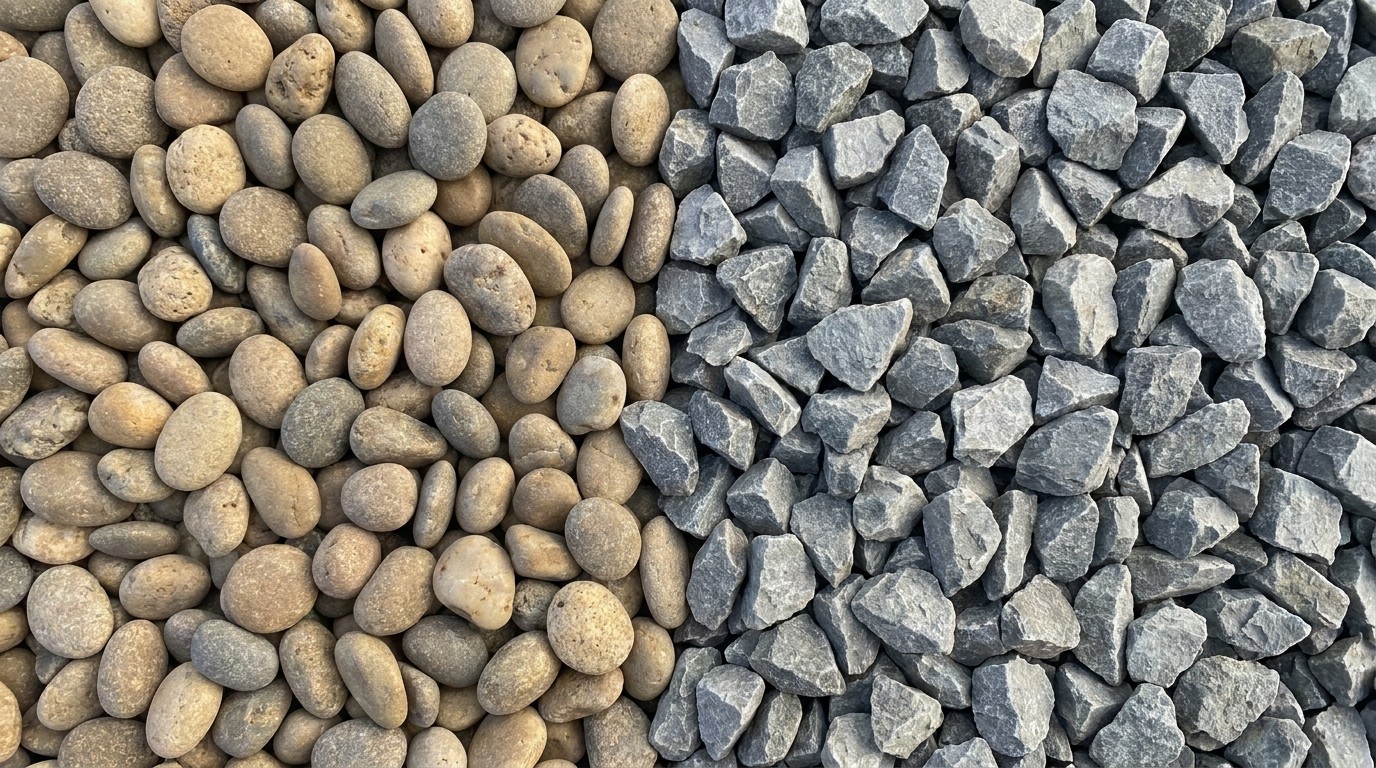
Pea Gravel vs. Crushed Rock at a Glance
In one line: pea gravel wins where people and paws go; crushed rock wins where weight and water go.
| Property | Pea Gravel | Crushed Rock (Crushed Stone) |
|---|---|---|
| Shape / edges | Smooth, rounded | Angular, jagged |
| Typical size | ~3/8″ | 3/4″, 5/8″ minus, etc. |
| Compacts / locks? | No — stays loose, shifts | Yes — interlocks, stays put |
| Comfortable underfoot? | Yes | No (sharp) |
| Drainage | Excellent (won’t compact) | Good; “minus” with fines drains less |
| Best for | Patios, paths, dog runs, playgrounds, decorative fill | Driveways, bases, French drains, under pavers, load-bearing |
| Sold as | By the cubic yard, delivered (1-yard min) | By the cubic yard, delivered (1-yard min) |
Use the next table to go straight from your project to a pick.
| Job | Best pick | Why (one line) |
|---|---|---|
| Patio / walkway | Pea gravel | Smooth, rounded stone is comfortable underfoot (edge it + compacted base). |
| Driveway | Crushed rock | Angular edges lock under vehicle weight and stay put; pea gravel ruts. |
| French drain / drainage | Crushed rock (clean / “drain rock”) | Sharp, clean gaps carry water fast and won’t clog; avoid “minus” with fines. |
| Dog run | Pea gravel | Paw-friendly, drains and flushes, low odor; pick rounded and dust-free. |
| Playground / under swing sets | Pea gravel | Rounded stones cushion falls and won’t compact; install deep enough + edge it. |
| Paver base / under pavers | Crushed rock (road base / 3/4″-minus) | Compacts into the firm, stable base pavers need; pea gravel never locks. |
| Ground cover / decorative fill | Pea gravel (walkable) / either (non-traffic) | Pea gravel for walkable beds; either for non-traffic fill. |
A quick note on terms, because the right size matters as much as the right material.
| Material / term | Typical size / spec | Notes |
|---|---|---|
| Pea gravel | ~3/8″ rounded | Named for its pea-like size; smooth, walkable. |
| Crushed rock (common sizes) | 3/4″, 5/8″ minus, etc. | Angular; size/screening varies by job. |
| “Minus” (with fines) | e.g. 3/4″-minus / 5/8″-minus | Contains fines; compacts into a firm base (driveways, paver base). |
| “Clean” / “washed” (no fines) | washed, fines screened out | Free-draining; stays open under load. |
| Drain rock / #57 stone | ~3/4″–1″ clean, open-graded | The recognized clean drain-rock grading for French drains (defined as No. 57 stone in ASTM D448). |
The two terms that trip people up most are “minus” and “clean.” “Minus” rock (like 3/4″-minus) keeps its fine particles, so it packs down into a firm base — what you want under a driveway or pavers. “Clean” or “washed” rock has the fines screened out, so it stays open and free-draining — what you want in a French drain. Same rock type, opposite jobs. Crusher fines and decomposed granite are a related, finer product used for compacted pathways — distinct from both pea gravel and clean crushed rock.
Best Gravel for a Patio or Walkway
For a patio or walkway, pea gravel is the better choice — its smooth, rounded stones are comfortable underfoot, though it benefits from edging and a compacted base underneath to keep it from migrating.
The comfort is the whole point: rounded stones don’t bite into bare feet or shift into sharp ridges the way angular rock can. Two installation details make a pea-gravel patio last. First, edge it — a paver, steel, or stone border keeps the loose stone from spreading into the lawn. Second, build it over a compacted crushed-rock sub-base — this is the one spot where both materials cooperate: angular crushed rock locks into a firm, level pad underneath, and the pea gravel rides on top as the comfortable, free-draining wearing surface. That layering also keeps the patio puddle-free, since the gravel drains rather than holding water. If you’re leaning toward a fully paved surface instead, see our pavers guide.
Crushed Rock vs. Pea Gravel for a Driveway
For a driveway, choose crushed rock: its angular edges lock together under vehicle weight and stay put, while pea gravel’s round stones scatter, rut, and migrate under tires.
Think of it in two layers. The base is compacted crushed rock — usually a 3/4″-minus or road base, whose fines pack down into a firm, load-bearing pad. If you want a cleaner, more decorative finish, you can add a crushed-rock top course over it. Pea gravel fails as a driving surface for a simple mechanical reason: round stones can’t interlock, so tires push them aside — the driveway ruts, the stone kicks out into the yard, and you’re topping it up constantly. The only pea-gravel driveway that really works is a low-traffic one with firm edging and an owner who doesn’t mind replenishing it.
One local note from the yard: our Idaho freeze-thaw winters are hard on a poorly built driveway — water that sits in a loose, unstable surface heaves when it freezes, then settles when it thaws. A properly compacted crushed-rock base handles that cycle far better than loose round stone. (That’s practical local guidance, not an engineering spec — but it’s the difference we see between a driveway that lasts and one that doesn’t.)
What Affects the Cost & How It’s Sold (Pea Gravel vs. Crushed Rock)
What you pay for gravel comes down to a handful of drivers — and the smartest move is to understand them, then get a current local quote.
What drives the cost (what makes one load cost more than another):
- Material / type — standard crushed rock generally costs less than decorative or specialty stone.
- Size / screening — clean, washed rock takes an extra processing step versus “minus” with fines.
- Color — natural gray runs cheaper than colored or specialty stone.
- Quantity — more cubic yards on one load is more economical per yard than a single-yard order.
- Delivery distance — delivery is priced by how far the truck travels.
How it’s sold (neutral, non-price facts): both pea gravel and crushed rock are sold by the cubic yard (1-yard minimum), delivered. You order the cubic yards your project needs (see “How much do you need?” below) — it arrives loose by the yard, with no bags to haul or stack.
For current pricing, visit or call Victory Greens. As we tell every customer: “We always guarantee the best price, and we deliver.”
Best Gravel for Dog Runs, Playgrounds & Other Uses
Dog runs
For a dog run, pea gravel is usually best — it’s gentle on paws, drains well so urine flushes through, and doesn’t hold heat or odor the way fines do; choose a rounded, dust-free pea gravel.
The round shape is easy on paws, and the open drainage means waste rinses through instead of pooling. Steer clear of anything with a lot of fines or sharp edges — that’s what holds odor and bothers feet.
Playgrounds / under swing sets
Pea gravel is a recognized playground surface under swing sets because rounded stones cushion falls and won’t pack into a hard pad — but it only protects if you install it deep enough and keep it edged in and topped up.
How deep is deep enough? The U.S. Consumer Product Safety Commission lists pea gravel among the appropriate loose-fill surfaces in its Public Playground Safety Handbook, and sets the depth by fall height. Its guidance: never use less than 9 inches of loose-fill, and at a 9-inch compressed depth pea gravel protects a fall height of about 5 feet. Because loose-fill settles and compacts over time, you start higher than 9 inches to keep 9 inches once it beds in, and you re-level it regularly — especially under swings and at slide exits, where little feet kick it out fastest. For context, engineered playground surfaces are tested for impact attenuation to ASTM F1292, and engineered wood fiber has its own material spec (ASTM F2075). Pea gravel is a loose-fill surface, not an engineered-wood-fiber product, so don’t expect it to behave like a certified engineered surface — install it to the CPSC depth and maintain it.
Paver base / under pavers
Under pavers, use crushed rock (road base / 3/4″-minus), not pea gravel — angular rock compacts into the firm, stable base pavers need, while round pea gravel never locks and lets pavers settle unevenly.
This is the same logic as the driveway base: pavers need a rigid, compacted platform, and only angular “minus” rock delivers it.
Ground cover / decorative fill
For ground cover, pea gravel is the better walkable choice for beds and borders you’ll step into, while either material works for non-traffic decorative fill where comfort doesn’t matter.
If you’re weighing rock against bark for a low-maintenance bed, that’s its own trade-off — see our bark vs. rock guide.
French Drains & Drainage: Which Gravel Drains Better?
For a French drain, use clean, angular crushed rock (drain rock) — its sharp edges leave large, consistent gaps that carry water fast and won’t clog; avoid “minus” rock with fines, which packs down and slows drainage.
The whole job of a French drain is to move water, and clean open-graded rock keeps the voids it needs to do that. The recognized clean drain-rock grading is #57 stone — roughly 3/4″–1″ and washed of fines (defined in ASTM D448). Land-grant guidance backs the same approach: Oregon State University Extension’s Rain Gardens fact sheet calls for a 12-inch layer of 3/4-inch washed drain rock around a perforated underdrain pipe.
Both materials drain well, but clean crushed rock drains fastest because its angular gaps stay open under load, while pea gravel — though very permeable — can shift and pack tighter over time. For a drain you bury and forget, crushed rock wins; for a permeable walking surface, pea gravel is fine.
How Much Do You Need? (Sizing)
To size an order, multiply the area you’re covering by the depth you want (in feet) to get cubic feet, then divide by 27 to get cubic yards — the unit you’ll order by (1-yard minimum).
For a typical depth rule of thumb and to get your exact cubic yards for your project, use our yardage guide.
Where to Buy Pea Gravel & Crushed Rock Near You (Boise / Meridian)
In the Boise Valley, you can buy both pea gravel and crushed rock at Victory Greens Stone & Garden Center — 4975 S Meridian Rd, Meridian, ID — which stocks 50+ bins of decorative rock (pea gravel, crushed rock, black & tan, and more), sells by the cubic yard (1-yard minimum), and delivers across the valley.
Victory Greens has been family-owned since 1993 and serves Meridian, Boise, Nampa, Caldwell, Eagle, Kuna, and Star. Whatever the job points to — pea gravel for the patio, crushed rock for the driveway base — you can pick it up or have it delivered, and the team can help you match the size to the use. “We always guarantee the best price, and we deliver.”
Frequently asked questions
Pea gravel vs crushed rock — which is better?
Neither is universally better. Choose crushed rock where you compact or carry weight (driveways, bases, French drains); choose pea gravel where people, pets, and play go (patios, paths, dog runs, playgrounds).
What’s the difference between pea gravel and crushed rock?
Pea gravel is small, smooth, rounded stone (about 3/8″). Crushed rock — also called crushed stone — is larger rock mechanically crushed into angular, jagged pieces with sharp edges.
Is pea gravel or crushed rock better for a patio?
Pea gravel, for comfort underfoot — installed with edging and over a compacted crushed-rock sub-base so it stays put and drains.
What gravel is best for a French drain or drainage?
Use clean, angular crushed rock (drain rock). Its sharp edges leave large, consistent gaps that carry water fast and won’t clog; avoid “minus” rock with fines, which packs down and slows drainage.
What is the best gravel for a dog run?
Pea gravel — it’s gentle on paws, drains so urine flushes through, and holds little odor; pick a rounded, dust-free pea gravel.
How much does pea gravel cost in Boise (per yard)?
What you pay depends on the material/type, size, color, quantity, and delivery distance. Both pea gravel and crushed rock are sold by the cubic yard (1-yard minimum), delivered. For current pricing, call or visit Victory Greens — we always guarantee the best price, and we deliver.
Where can I buy pea gravel near me in Boise / Meridian?
Victory Greens Stone & Garden Center, 4975 S Meridian Rd, Meridian, ID — 50+ bins of decorative rock, sold by the cubic yard (1-yard minimum), delivered across the Boise Valley.
What gravel is best under pavers / for a paver base?
Crushed rock (road base / 3/4″-minus), not pea gravel — angular rock compacts into the firm, stable base pavers need; round pea gravel never locks and lets pavers settle unevenly.
Crushed rock vs gravel for a driveway
Crushed rock — its angular edges lock together under vehicle weight and stay put, while pea gravel’s round stones scatter, rut, and migrate under tires.
How much pea gravel or crushed rock do I need?
Multiply area by depth, then divide by 27, to get cubic yards (the unit you order by, 1-yard minimum). Use the Victory Greens yardage guide to get your exact amount.
Is pea gravel good for a playground?
Yes — the CPSC Public Playground Safety Handbook lists pea gravel as an appropriate loose-fill surface, because rounded stones cushion falls and won’t pack into a hard pad. Keep it deep enough: never less than 9 inches, which protects a fall height of about 5 feet, and re-level it regularly (especially under swings). Pea gravel is a loose-fill surface, not a certified engineered one, so depth and upkeep are what make it safe.
Does pea gravel or crushed rock drain better?
Both drain well, but clean crushed rock drains fastest because its angular gaps stay open under load, while pea gravel — though very permeable — can shift and pack tighter over time. For a drain you bury and forget, crushed rock wins; for a permeable walking surface, pea gravel is fine.
About the author
Tim Mussell is President and co-founder of Victory Greens Stone & Garden Center. He started the yard with Carol Mussell in the spring of 1993 and has spent about 33 years helping Treasure Valley homeowners and contractors pick — and haul — the right stone for the job. Victory Greens is at 4975 S Meridian Rd in Meridian, Idaho.
Comments are closed