
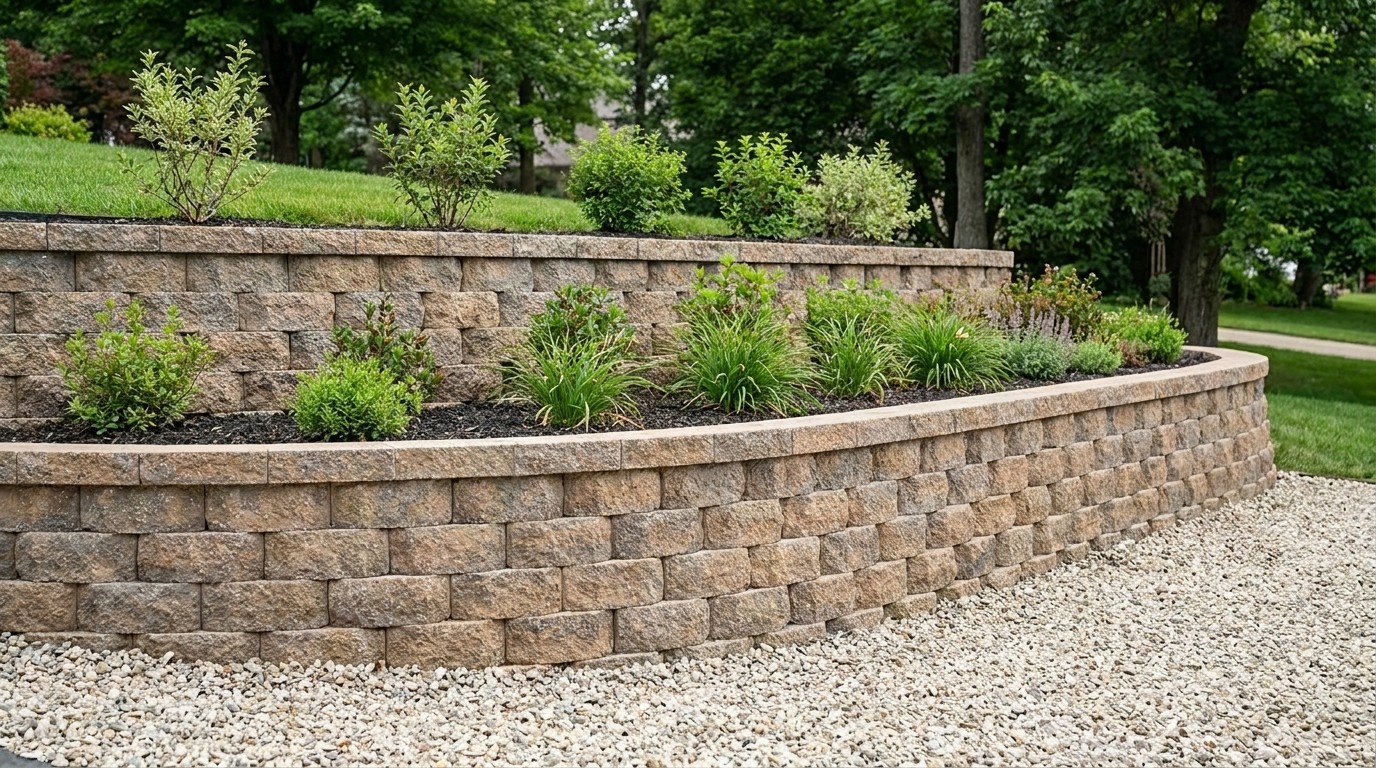
Working draft for staging review — bracketed markers are open editorial items.
Railroad Tie Alternatives in the Boise Valley: What to Use Instead (and Why We Stopped Carrying Ties)
By Tim Mussell, Owner & President, Victory Greens Stone & Garden Center — Meridian, Idaho. Tim and Carol Mussell founded Victory Greens in 1993; Tim has run the stone-and-garden yard for more than thirty years — including the years it carried, and then deliberately stopped carrying, railroad ties.
For a raised garden bed, retaining wall, or landscape border for your yard in the Boise Valley, skip railroad ties and use an environmentally friendly material instead: planter wall block, retaining-wall block, or natural stone for walls and raised beds, and for borders, concrete edging stone or natural ledge stone. Victory Greens in Meridian used to carry railroad ties and stopped — old ties are treated with creosote, which the EPA regulates as a restricted-use wood preservative and which ATSDR reports the EPA classifies as probably carcinogenic to humans, and they rot, warp, and lean long before block or stone does. Our safer, more modern alternatives are in stock at our yard at 4975 S Meridian Rd, and we deliver.
What to use instead of railroad ties in Boise
If you’re replacing railroad ties, the right modern material depends on the job — but in every case it’s block, natural stone, or engineered edging, not another creosote tie. Here’s the short version by application, all of it in stock at our yard.
| Project | Skip — railroad ties (why) | Use instead — in stock at Victory Greens |
|---|---|---|
| Raised garden bed / edible garden | Creosote can migrate into garden soil (see the safety section) | Natural stone or retaining-wall block — no creosote |
| Retaining wall | Rot, warp, and lean; short-lived; height-limited | Retaining-wall block or natural stone — engineered and long-lived → see our retaining wall page |
| Landscape border / edging | Heavy, splinters, creosote on contact | Concrete edging stone or natural ledge stone — or our Pavingstone curbing → see edging |
For a raised garden bed, natural stone or retaining-wall block is a no-creosote, decades-long alternative to railroad ties — and unlike wood, it never rots. Most guides answer “what should I use instead of railroad ties for a raised garden bed?” with wood only — untreated fir or pressure-treated lumber. But the answer they leave out is stone: a raised garden bed built from natural stone or stackable retaining-wall block holds soil for decades, puts no wood preservative anywhere near what you grow, and never needs replacing as it weathers. That’s the option we hand Boise gardeners first. And an added bonus: there’s no chemical smell and no risk of contaminating our precious water sources.
For borders, our Pavingstone curbing is the standout. Wood edging is the usual default, but it’s comparatively short-lived — it rots, warps, and needs replacing. Victory Greens’ natural-stone-look Pavingstone curbing is the upgrade: it looks great, lasts a lifetime, and is easier to install than risking injury wrestling with timber edging or railroad ties.
Why we stopped carrying railroad ties
We used to sell railroad ties at Victory Greens, and we deliberately stopped — because once you’ve handled them by the truckload, you stop wanting them in a customer’s garden. This isn’t a knock on anyone; it’s what thirty-plus years of moving this material taught us.
And the day-to-day reality sealed it: railroad ties stink — they off-gas and weep in the heat and full sun, and that toxic smell is the creosote doing exactly what you don’t want it doing in a vegetable bed. They also stain your clothes on contact — sit on a tie or brush against one and you’ll wear it home. Those are the everyday details a business still selling ties won’t volunteer, and they’re the practical reason we moved our customers to block and stone.
Railroad ties are treated with creosote, a wood preservative the U.S. EPA regulates as a restricted-use pesticide — sold only for industrial wood treatment by certified applicators, not to homeowners — and which ATSDR reports the EPA classifies as probably carcinogenic to humans. Coal-tar creosote components can dissolve in water and move through soil toward groundwater, which is why creosote-treated wood is advised against for raised vegetable beds and around where children play. The honest takeaway for an Idaho gardener: there’s no upside to putting a restricted-use pesticide next to your food when stone and block do the same job without it.
Old ties are treated with creosote that can pose chemical and environmental risks, especially near pets, edible plants, or groundwater. Creosote has a toxic odor and can seep out over time and contaminate adjacent soil. The oily residue can be risky to handle and leaves stains, and it is not recommended for children’s play areas. The oily creosote compounds can cause skin irritation and long-term health concerns with repeated exposure.
Creosote can also leach out with sprinkler or rain water, contaminating the soil. It affects the microorganisms in the soil that plant growth depends on. The petroleum-like residues end up in the groundwater and eventually contaminate drinking wells — and it is difficult to remove once it’s found.
One more practical caution from the yard: creosote isn’t something you want near your garden or your pets. Dogs chew on ties, lie against them, and track in whatever the wood sheds — and given what the EPA and ATSDR document about creosote, that’s a risk I’d steer any customer away from.
Where NOT to use ties. Avoid railroad ties near vegetable or herb gardens, anywhere children crawl or play, and any area adjacent to wells, drainage, ditches, swales, or ponds. It is definitely not a good choice for a retaining wall where groundwater moves through or pools against it — the preservatives that leach out have real potential to become a contamination issue.
Railroad ties also crack and splinter as they age and gray out, leaving your outdoor living space substandard at best. They’re heavy and awkward to handle, which makes installation a physical risk — be careful to avoid injury if you choose them.
Between my employees handling them, the risks around vegetable gardens, and water contamination, staying away from railroad ties was an easy choice for me.
How long do railroad ties last vs. block and stone?
Modern materials simply outlast railroad ties: a tie wall tends to rot, warp, and lean and is comparatively short-lived, while engineered retaining-wall block and natural stone hold for generations. General hardscape-industry figures put tie walls in the range of roughly fifteen to thirty years before they fail, versus fifty to a hundred-plus years for block and stone — and tie walls are usually best kept low, under about four feet, because they lean. The strategic point isn’t the exact number — it’s that modern materials outlast ties, so you build the wall or bed once.
Railroad ties and retaining walls: the structural angle
For a retaining wall, the case against railroad ties is structural as well as chemical: tie walls lean and are height-limited, while modern retaining-wall systems are engineered to hold their line and their height. A creosote tie wall moves as the wood rots and warps; an engineered block or natural-stone wall is built to spec and stays put. For anything load-bearing or above roughly knee-to-hip height, that’s the difference between a wall you build once and one you rebuild.
Since a retaining wall’s whole job is to hold back soil, our retaining-wall blocks come engineered to do it and hold up when installed correctly. Seldom does a homeowner or contractor get a railroad-tie retaining wall properly engineered. Most folks figure if they drill a few holes and drive in some rebar they’re good to go — and nothing could be further from the truth. Between hydraulic pressure and our Idaho freeze-thaw winters, a railroad-tie wall will almost always lean over time.
For the wall material itself, see our retaining wall page and our guide to blocks vs. natural stone for retaining-wall projects.
Where to buy the modern alternative near Boise
You can buy every one of these modern materials locally: Victory Greens stocks retaining-wall block, natural stone, flagstone and patio stone, landscape edging, natural-stone-look Pavingstone curbing, and pavers at 4975 S Meridian Rd in Meridian, and we deliver across the valley. That’s Meridian, Boise, Eagle, Nampa, Caldwell, Kuna, and Star. Match the material to your project from the table above, or bring us the project and we’ll point you to the right one:
- Raised garden beds → flagstone and patio stone, natural stone, or retaining-wall block
- Retaining walls → retaining wall block and natural stone
- Borders and landscape edging → edging and natural-stone-look Pavingstone curbing
- Patios and paths → pavers
Pricing depends on the material, its size and color, how much your project needs, and delivery — so call or visit the yard for a current quote. We always guarantee the best price, and we deliver.
Frequently asked questions
What can I use instead of railroad ties in the Boise Valley?
Use a modern material matched to the project: natural stone or retaining-wall block for raised beds and walls, stone or steel edging for borders — all in stock at Victory Greens in Meridian, which delivers across the valley.
What should I use instead of railroad ties for a raised bed or retaining wall?
For a raised bed, use natural stone or retaining-wall block (no creosote, and it never rots). For a retaining wall, use engineered retaining-wall block or natural stone — long-lived and built to hold its line. See our retaining wall page.
Where can I buy raised-bed, retaining-wall, or garden-edging material near me in Boise or Meridian?
At Victory Greens, 4975 S Meridian Rd, Meridian, ID 83642. We stock retaining-wall block, natural stone, flagstone, edging, and pavers, and we deliver across the Treasure Valley. We always guarantee the best price, and we deliver.
Are railroad ties safe for raised garden beds or vegetable gardens?
No. Railroad ties are treated with creosote, which the EPA regulates as a restricted-use wood-preservative pesticide and which ATSDR reports the EPA classifies as probably carcinogenic to humans; its components can move through soil, so creosote-treated wood is advised against for raised vegetable beds. Use a no-creosote alternative instead — natural stone or retaining-wall block.
Do railroad ties leach creosote into soil?
Creosote can migrate from treated wood into the surrounding environment — ATSDR reports that some components of coal-tar creosote dissolve in water and can move through soil toward groundwater — and ties weep and off-gas more in heat (in our own experience selling them, they stink in the summer sun). For a raised bed, that risk is the reason to choose stone or block.
How long do railroad ties last compared with retaining wall blocks?
Railroad-tie walls are short-lived and tend to rot, warp, and lean, while engineered retaining-wall block and natural stone last far longer — general hardscape-industry figures put tie walls well below the lifespan of block and stone. The practical point: build with block or stone and you build it once. (This is a general industry range, not a Victory Greens guarantee.)
Are railroad ties safe for landscaping?
For anything where people, pets, food, or bare skin make contact, no — creosote is a restricted-use pesticide (EPA) that ATSDR reports the EPA classifies as probably carcinogenic to humans, and ties splinter, off-gas, and stain on contact. Modern materials — block, natural stone, and edging — do every landscaping job without it, and we stock them locally.
Come pick the right material at Victory Greens
Skip the railroad ties — come pick the right modern material for your project at Victory Greens in Meridian. Visit the yard at 4975 S Meridian Rd or call for current pricing on retaining-wall block, natural stone, edging, or pavers. We always guarantee the best price, and we deliver.
Comments are closed