
Working draft for staging review — bracketed markers are open editorial items.
Flagstone Patio Base in Boise: Dry-Laid on Gravel and Sand, or Mortar — What Survives Idaho Freeze-Thaw?
By Tim Mussell, co-founder and President of Victory Greens Stone & Garden Center — a family-owned stone and garden yard supplying Boise-area patios since 1993.
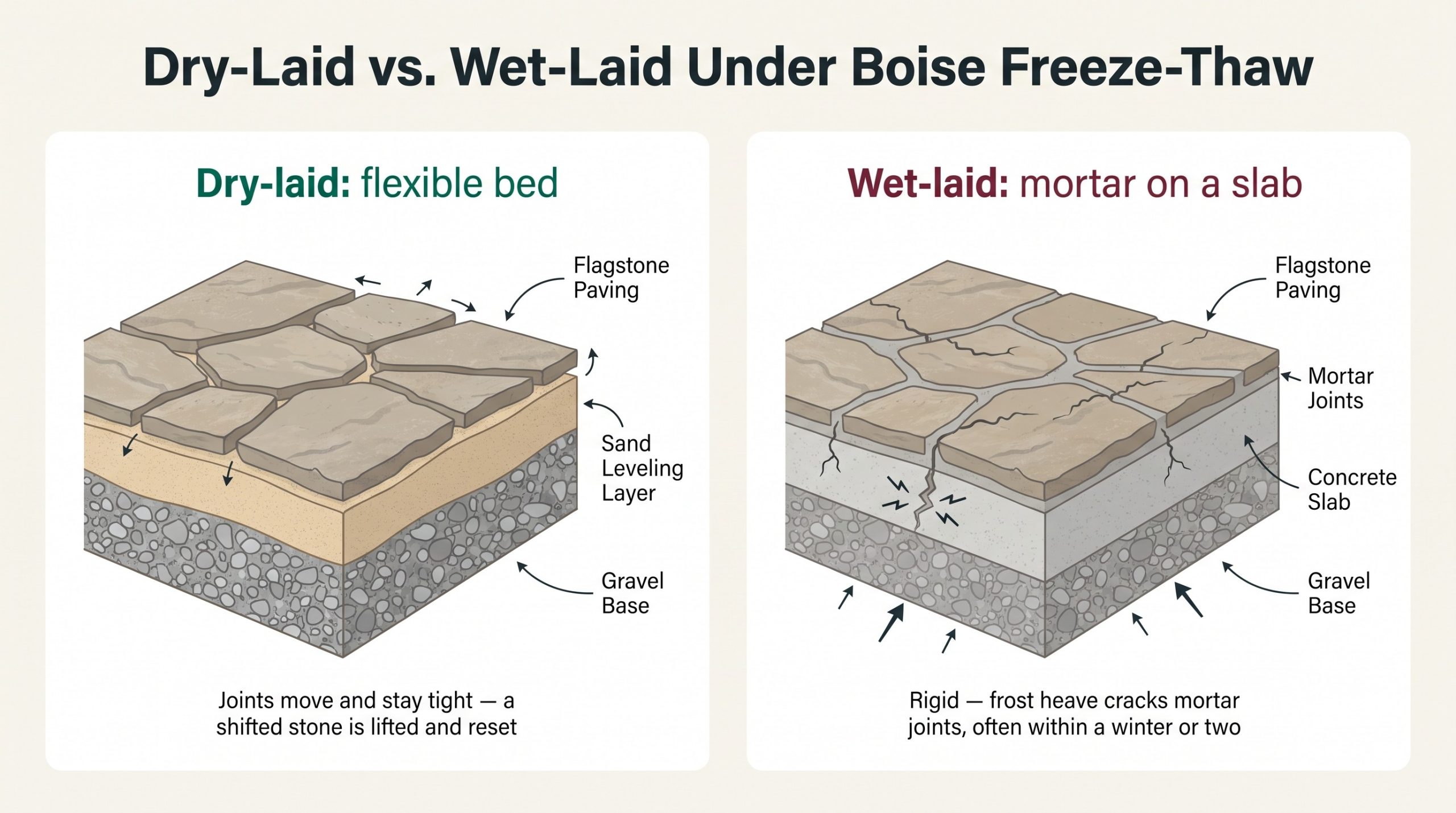
In Boise’s freeze-thaw climate, the safest way to set a flagstone patio is dry-laid: lay the stone on a compacted gravel base topped with a leveling course of stone dust (quarry screenings) or bedding sand, and fill the joints with stone dust rather than mortar. A dry-laid bed flexes with the seasonal ground movement that our winters cause, so it stays tight for decades and any shifted stone can be reset. Mortaring flagstone onto a slab gives you a rigid surface that frost heave tends to crack within a winter or two — so reserve wet-laid (mortar-on-slab) flagstone for the narrow case where you already have a sound, frost-protected concrete pad.
Dry-laid vs. wet-laid flagstone, at a glance
Dry-laid and wet-laid are the two ways to set a flagstone patio, and in a freeze-thaw climate dry-laid on a flexible gravel-and-sand bed is the safer, longer-lasting choice while wet-laid mortar-on-slab is the narrow exception. Here is how the two methods compare.
| Dry-laid (gravel base + sand/screenings) | Wet-laid (mortar on a slab) | |
|---|---|---|
| How it’s built | Flagstone set into a compacted gravel base topped with a stone-dust or bedding-sand leveling course; joints filled with stone dust. | Flagstone bedded in a mortar setting bed over a cured, frost-protected concrete slab. |
| How it handles freeze-thaw | Flexes with seasonal ground movement; the bed and joints move and stay tight. | Rigid; frost heave tends to crack the mortar joints, often within a winter or two. |
| Repairability | A shifted stone can be lifted and reset; the bed is reworkable. | Cracked mortar is patched, not reset; failures spread along the joints. |
| Best for | Patios, walkways and garden paths over native ground in a cold climate. | Resurfacing an existing sound slab, or a formal monolithic look where the slab is engineered against frost. |
| Our Boise verdict | The safer, longer-lasting default for our winters. | A narrow exception — only over a slab you already know is sound. |
Base depth and how much material to order are a separate question — see our paver-base depth guide.
Why Boise’s freeze-thaw climate favors a flexible bed
Freeze-thaw decides the method here because a rigid surface over ground that moves with frost has nowhere to give. When trapped moisture freezes and expands, frost heave lifts and shifts whatever sits on top; a rigid mortar-and-slab assembly can’t absorb that movement, so the mortar joints crack first while the rest of the surface follows. A dry-laid bed does the opposite — the compacted gravel and the sand-or-screenings leveling course flex with the ground and settle back, and any stone that does shift can simply be reset.
The local conditions make this more than a general rule. We get a hard enough winter that the City of Boise and Ada County building code sets a 24-inch frost depth — a neutral measure of how far seasonal frost reaches here. On top of that, much of the Treasure Valley runs on silty, clay-bearing soil that can be moderately to highly expansive, with poor drainage the main driver of the swelling and shrinking (Idaho Transportation Department research, RP154). Frost movement over reactive ground is exactly the condition a flexible, well-drained dry-laid system is built to ride out — and a rigid mortar slab is exactly what it tends to break.
Does a mortared flagstone patio crack in freeze-thaw?
Yes — in a hard-winter freeze-thaw climate, mortaring flagstone over a flexible base is the failure mode, not the fix. A rigid mortared top sitting on ground that moves with frost can’t flex with it, so the mortar joints crack and pop, often within a winter or two, and grade-level cement is especially prone to it. The common myth is that mortar is the “permanent” or “premium” install — but mortar is the rigid one, and rigid is precisely what freeze-thaw breaks. The durable, resettable choice in our climate is dry-laid: a flexible bed moves with the ground and any displaced stone gets reset rather than rebuilt (craftsman technique authority DevineEscapes, on why a rigid top over a flexible base cracks; neutral frost-heave sources on how heave fails rigid joints first).
How to lay a flagstone patio that lasts (the dry-laid recipe)
Lay a flagstone patio that lasts here by building a flexible system from the ground up, in four steps. The recipe is the method; how deep each layer goes and how much to order is the sibling guide’s job.
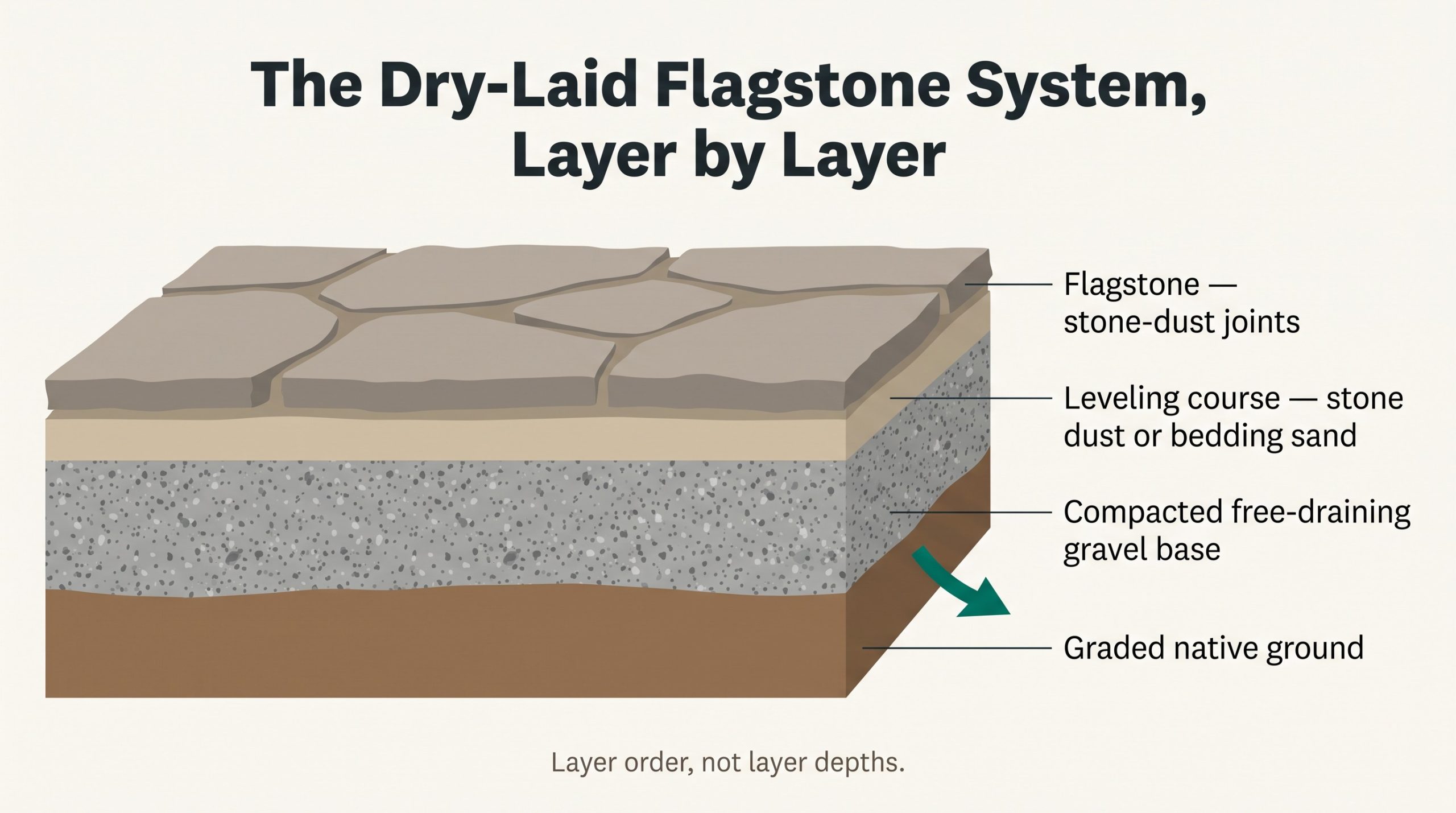
- Build a compacted, free-draining gravel base. A compacted gravel base is the foundation a dry-laid flagstone patio rests on, and keeping it free-draining is what lets the system shed water before frost can heave it. For how deep the base should go and how much to order for our freeze-thaw climate, see our paver-base depth guide.
- Add a stone-dust or sand leveling course. Spread a leveling course of stone dust (quarry screenings) or bedding sand over the base to seat each stone and absorb flagstone’s natural thickness variation — one stone may want a thinner bed in one spot and a thicker one a foot away.
For a flexible dry-laid bed, stone dust (screenings) is usually the better leveling and joint material than plain sand: sand washes out, blows away, and gets excavated by ants, while the fines in screenings lock together and settle helpfully (DevineEscapes). The caveat to carry: stone dust drains more slowly than sand, so a thick screenings bed over poor drainage can itself trap water and frost-heave. Pair it with a free-draining compacted base and grade the finished surface away from the patio so water leaves rather than freezes underneath. It’s screenings-over-sand with the drainage caveat, not an unqualified rule.
- Set the flagstone. Fit and seat each flagstone into the leveling course, tapping it level so it sits firmly with no rock or wobble.
- Fill the joints with stone dust. Fill the joints with stone dust or screenings for flexible joints that move with the bed (see jointing, below).
Flagstone joints: stone dust or polymeric sand?
For irregular dry-laid flagstone in a freeze-thaw climate, flexible joints — stone dust or screenings — suit the flexible bed, because they move with the stones as the ground shifts seasonally. Polymeric sand, by contrast, tends to crack and separate on irregular stone as the units shift, since it’s meant to set hard. If you want the full polymeric-versus-stone-dust breakdown, see our paver joint-sand guide; here we keep it to what the method verdict needs.
When wet-laid (mortar on a slab) is the right call
Wet-laid flagstone earns its place in one narrow situation: over a sound, cured, frost-protected concrete slab. Irregular flagstone set this way needs a true mortar setting bed — roughly a 1–2-inch mortar bed over a 4–6-inch slab — rather than thinset, because only a real mortar bed can absorb the stone’s thickness variation (natural-stone installation guidance, STONEarch / Landscaping Network; Hunker on the mortar-bed-versus-thinset point). The two defensible cases are resurfacing an existing slab you already know is sound, or a formal monolithic look where the slab itself is engineered against frost. Absent that engineered slab, the slab can crack in our winters along with the mortar — which is exactly why dry-laid is the safer default for a patio here.
What a flagstone patio takes (cost drivers) and getting your stone
What a flagstone patio costs comes down to a handful of drivers, not a single sticker price: the flagstone type and thickness, the square footage, whether you go dry-laid or wet-laid, the base material, and how far it’s delivered. Those are the levers that move a project up or down, and they’re worth thinking through before you order.
Here’s how the material is sold at Victory Greens: flagstone and patio stone go by the pound or ton, and the base gravel and bedding sand go by the cubic yard, with a one-yard minimum, delivered — we don’t sell rock by the bag. For current pricing on any of it, call or visit Victory Greens; we’ll size the order to your patio.
Get your flagstone and base material in Boise
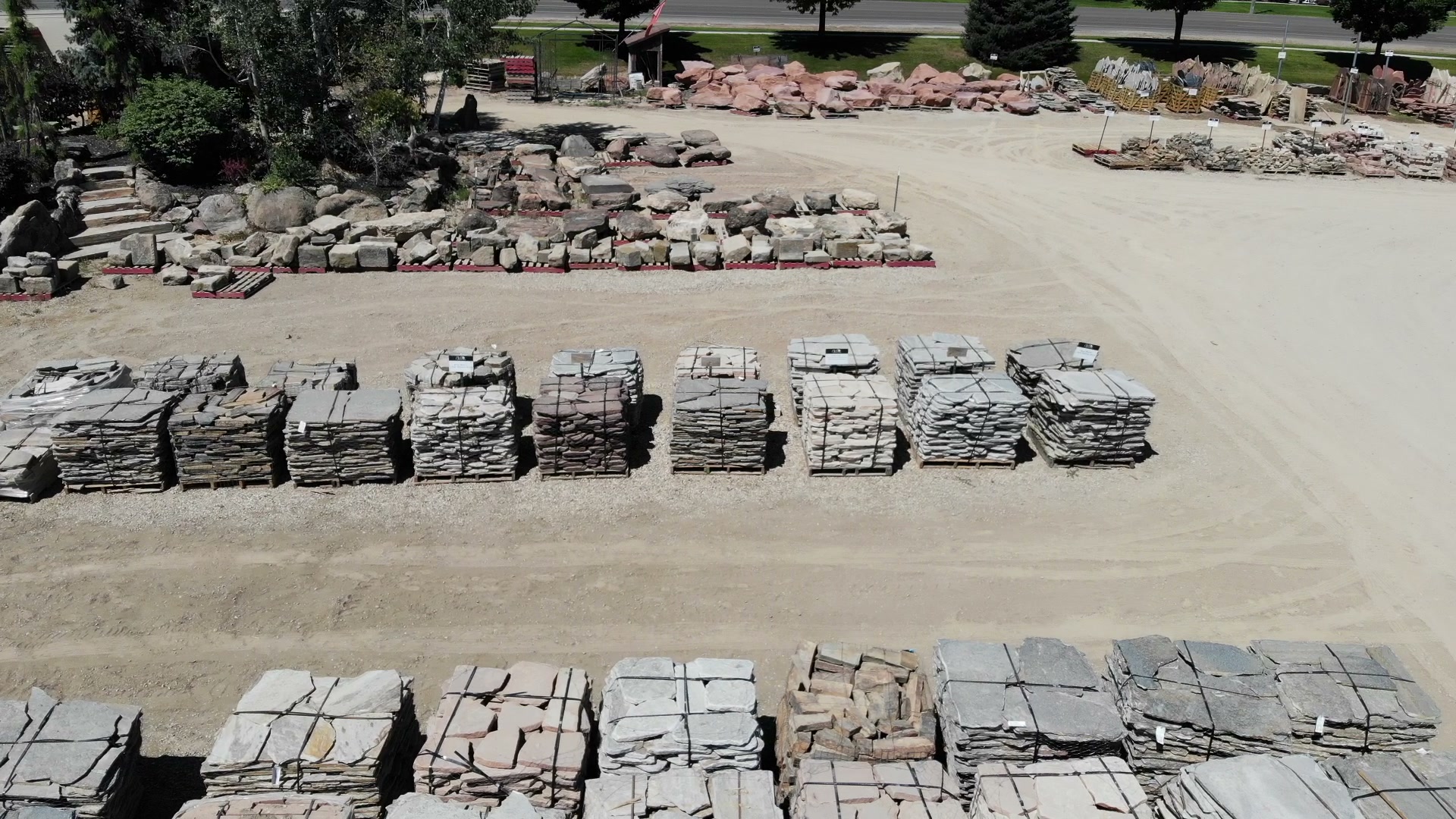
Victory Greens Stone & Garden Center is your local source for flagstone and the base material to set it. We’re a family-owned stone and garden yard, in business since 1993, with a BBB A+ rating, at 4975 S Meridian Rd in Meridian, ID. We stock flagstone and patio stone by the pound or ton, plus the compacted-gravel base and bedding sand or stone dust by the cubic yard to build a dry-laid bed that survives our winters — and we deliver across the area, including Meridian, Boise, Eagle, Nampa, Caldwell, Kuna, and Star.
We always guarantee the best price, and we deliver. Come see the stone in the yard, or call us to plan your patio — and for how deep to build the base and how much material to order, start with our paver-base depth guide.
For choosing between flagstone and pavers in the first place, see our pavers vs. flagstone surface guide, and for the full build sequence, our step-by-step backyard paver patio walkthrough.
Frequently asked questions
What do I set flagstone on — sand, gravel, or mortar?
Dry-lay it on a compacted gravel base topped with a leveling course of stone dust (quarry screenings) or bedding sand, and fill the joints with stone dust. In a freeze-thaw climate like Boise’s, this flexible bed outlasts mortar, which tends to crack as the ground moves with frost.
Does a mortared flagstone patio crack in freeze-thaw?
Usually, yes — in a hard-winter climate. A rigid mortared surface over a base that moves with frost can’t flex, so the mortar joints crack and pop, often within a winter or two. A dry-laid bed flexes with the ground and any shifted stone can be reset.
How do you lay a flagstone patio?
Build a compacted gravel base, add a leveling course of stone dust or bedding sand, set the flagstone into it, then fill the joints with stone dust. (For how deep the base should be and how much to order, see our Boise paver-base depth guide.)
What’s the best base for a flagstone patio in Boise?
A compacted, free-draining gravel base with a stone-dust or sand leveling course — a flexible setting bed that handles our freeze-thaw winters. Reserve a mortared concrete slab for the narrow case where you already have a sound, frost-protected pad.
What do you fill flagstone joints with — stone dust or polymeric sand?
For irregular dry-laid flagstone in freeze-thaw, use flexible joints (stone dust / screenings) — they suit a bed that moves seasonally. Polymeric sand tends to crack and separate on irregular stone.
Where can I buy flagstone and patio stone near me in Boise?
Victory Greens in Meridian stocks flagstone and patio stone (sold by the pound or ton) plus the base gravel and bedding sand (by the cubic yard, 1-yard minimum, delivered) to set it. We always guarantee the best price, and we deliver — call or visit for current pricing.
About the author
Tim Mussell is co-founder and President of Victory Greens Stone & Garden Center, the family-owned stone and garden yard he and Carol Mussell started in 1993 at 4975 S Meridian Rd in Meridian, ID. Victory Greens supplies flagstone and patio stone along with the base gravel and bedding sand to set it, and delivers across the Treasure Valley.
Comments are closed