
Working draft for staging review — bracketed markers are open editorial items.
Backyard Fire Pits in Boise: What’s Allowed, Where to Put It, and What to Build It On
By Tim Mussell, owner of Victory Greens Stone & Garden Center — running the family stone and garden yard in Meridian, Idaho since 1993.
In Boise, you can have a wood-burning backyard fire pit without a permit as long as it’s an enclosed pit no bigger than 2 ft × 3 ft and kept at least 25 feet from your house, fence, or anything that can burn — 15 feet for an approved store-bought fire bowl. You only need a City of Boise bonfire permit if the fire is larger than that, or if you live north of Hill Road or Warm Springs Avenue. The part most guides skip is what to build it on: in the Treasure Valley’s freeze-thaw winters, set the pit on a deep, well-compacted angular crushed-gravel base — go heavier than the usual 4 inches — with a level paver-or-block surround, and never line the burn ring with river rock, which can trap moisture and crack or pop in the heat.
The two questions we get every summer
At the yard we get the same two questions every summer: “Am I even allowed to put in a fire pit?” and “What do I build it on so it doesn’t fall apart?” The rules are simpler than people fear, and the build is where most Boise fire pits go wrong — not in the ring you see, but in the base you don’t. Get both right and you’ll have a fire pit that’s legal, safe, and still level after a few Idaho winters.
Is it allowed, and do I need a permit?
An enclosed backyard fire pit no bigger than 2 ft × 3 ft does not need a permit in Boise. You only need a City of Boise bonfire permit if the fire is larger than that — or if you live north of Hill Road or Warm Springs Avenue.
That comes straight from the City of Boise Fire Department’s bonfire-permit rules, which apply to recreational fires that are not in an enclosed 2 ft × 3 ft fire pit. Go bigger than that, or live up in the Foothills above Hill Road or Warm Springs Avenue, and you’ll need the bonfire permit first.
Boise’s burn permit is a different thing — it’s for open or vegetation burning, like clearing fence lines or irrigation ditches, and it is not the rule for a recreational backyard fire pit.
A lot of folks read the burn-permit page, see “permit,” and assume they’re breaking the law by lighting a fire pit. They’re not. For a contained recreational fire in a proper pit, the bonfire-permit rule above is the one that applies.
Ada County’s closed fire season runs May 10 through October 20. That permit requirement is for open burning; a recreational fire in your enclosed backyard pit is exempt — but never burn on an air-quality “no-burn” day.
Use clean, dry, untreated wood, keep water or a hose within reach, and stay with the fire until it’s out. If you do need a permit for a larger fire, check the current fee with the City of Boise.
How far from the house, the fence, and anything that burns?
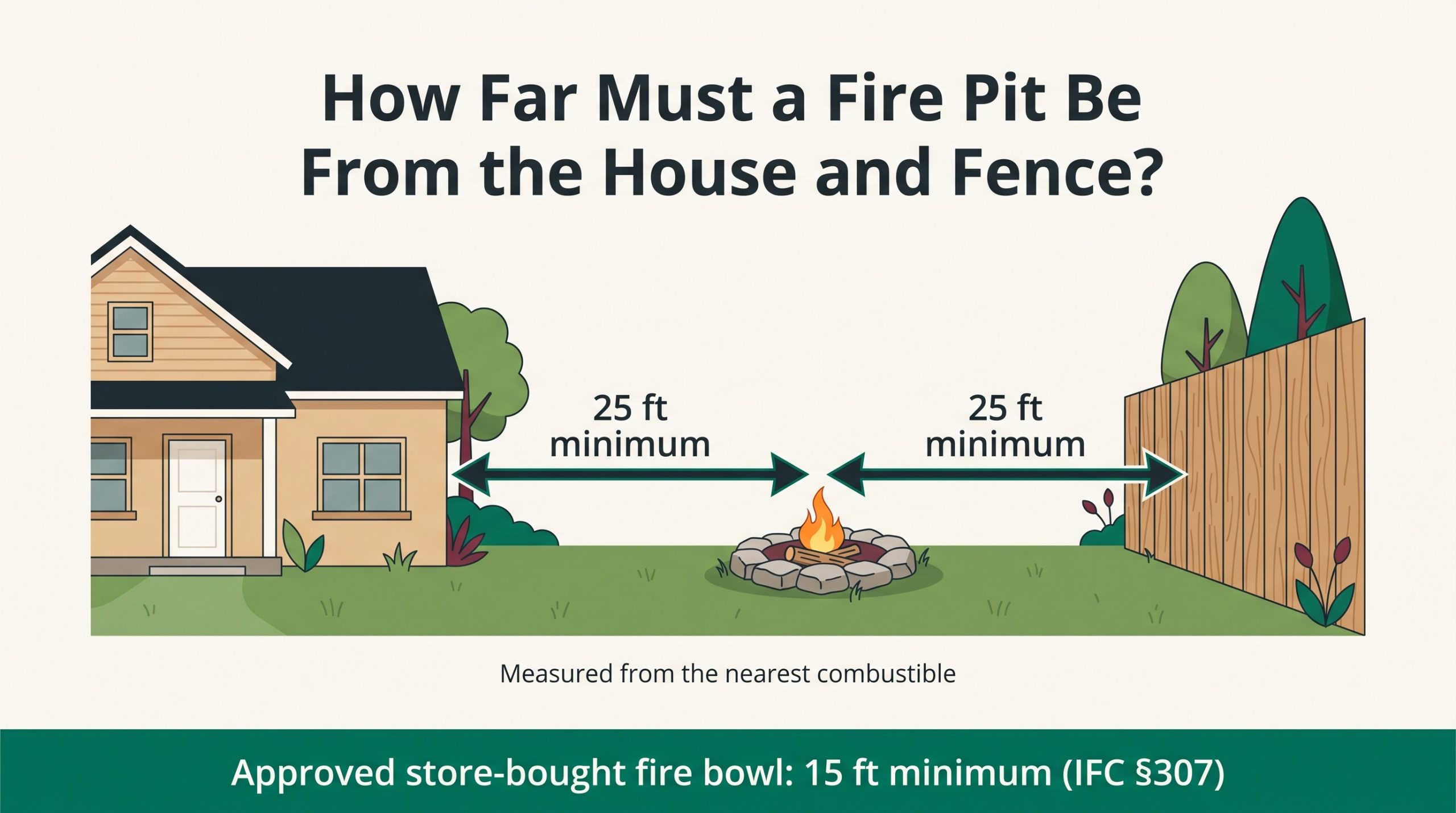
Keep a backyard fire pit at least 25 feet from your house, fence, and anything that can burn — or 15 feet for an approved store-bought fire bowl. A recreational fire should be no more than 3 feet across and 2 feet tall, and someone should attend it until it’s completely out.
Those are the recreational-fire setbacks in the International Fire Code (IFC §307), the same standard the City of Meridian Fire Department restates for our own city. Measure from the nearest combustible, not the middle of the yard, and clear dry grass, leaves, and overhanging branches inside that circle before you light it.
| Fire type | Minimum distance from anything combustible |
|---|---|
| Open recreational wood fire | 25 ft |
| Approved portable outdoor fireplace / store-bought fire bowl | 15 ft |
The half nobody tells you: what to build it on
This is where I spend most of my counter time — the half the national how-to videos skip, and the half that decides whether your fire pit is still level in three years.
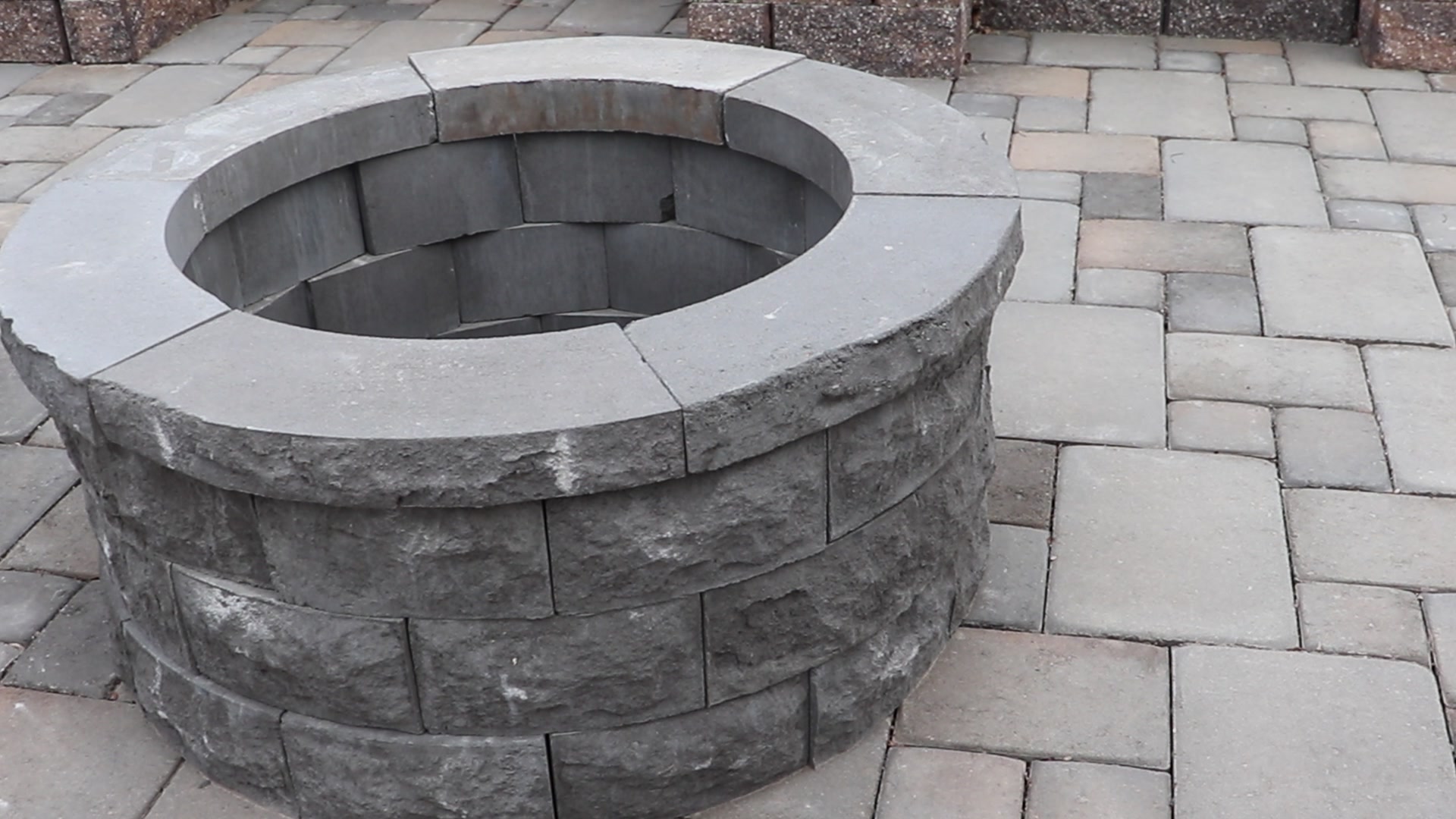
For an Idaho backyard fire pit, dig out the sod, lay a geotextile fabric, then build a deeper-than-average compacted base of angular crushed gravel (¾-inch road base) — go heavier than the usual 4 inches because freeze-thaw will heave a thin base — and set a level block or paver surround on top.
The reason is freeze-thaw. Water in the ground freezes, expands, and lifts whatever sits on it — that’s frost heave, and a thin or sloppy base is what it tears apart over a Treasure Valley winter. A deep, well-draining, compacted gravel base is your insurance against it. Here’s the build.
- Mark and dig out the sod. Never build on bare grass or loose soil — it settles and heaves. Dig down past the topsoil to firm ground.
- Lay geotextile fabric. It keeps soil fines from migrating up and clogging your drainage layer, so the gravel keeps doing its job for years.
- Add angular crushed gravel — ¾-inch road base, not round pea gravel. Angular stone locks together and holds compaction; round pea gravel rolls and won’t stay put under load.
- Go deeper for freeze-thaw, and compact in lifts. A general base is around 4 to 6 inches; in a cold, freeze-thaw climate you want to go deeper, compacted in 2-to-3-inch lifts so the whole thing is dense. Tell us your fire-pit size and your site and we’ll help you spec the right depth.
- Drainage first. Water that drains away can’t freeze, expand, and heave the surround — so grade the base so water moves down and out, not in.
- Set a level block or paver surround. A block fire-pit kit, or wall block and pavers, gives you a frost-tolerant, level ring on top of that base. Take your time getting it level — every course after the first one depends on it.
Here’s the one rock mistake we get asked about most: never line the inside of the burn ring with river rock or any smooth, wet, porous stone. Trapped moisture flashes to steam and the rock can crack or pop. Inside the ring, use fire brick, lava rock, or fire-rated pavers; save river rock for decorative ground cover away from the flame.
This isn’t a scare story — it’s physics. Water trapped in a tight, water-worn stone expands hugely as steam, and the rock relieves that pressure by cracking or popping (thermal shock, or spalling). Lava rock is full of tiny holes, so steam vents through it instead of building up — which is why it’s safe in the ring, along with fire brick and fire-rated pavers.
Where to get the materials in Boise
You can build the whole thing from materials we keep on hand. For the base, you want angular crushed rock — we sell landscape rock by the cubic yard, one-yard minimum, delivered to the job. For the surround, a block fire-pit kit, wall block, or pavers gives you that level, frost-tolerant ring; we carry Keystone block plus Garden Wall and Basalite pavers, and pair the Pavingstone and Basalite lines on our fire-pit page. Block, pavers, and kits sell by the unit or pallet.
We don’t post prices online — the right number depends on your fire-pit size, the stone you choose, your base depth, and the delivery distance — so call or visit Victory Greens for current pricing. Bring your dimensions to the yard and we’ll help you spec both the base and the surround.
We always guarantee the best price, and we deliver.
Victory Greens Stone & Garden Center is at 4975 S Meridian Rd in Meridian, Idaho — the local stone and garden yard since 1993, delivering across Boise, Meridian, Eagle, Nampa, and the rest of the Treasure Valley. For the rules, the City of Boise Fire Department confirms permits and current fees; for the build, come see us.
Frequently asked questions
Do I need a permit for a backyard fire pit in Boise?
No — an enclosed backyard fire pit no bigger than 2 ft × 3 ft does not need a permit in Boise. You need a City of Boise bonfire permit only if the fire is larger than that, or if you live north of Hill Road or Warm Springs Avenue. For the fee on a larger fire, check the current amount with the City of Boise.
How far should a fire pit be from the house?
At least 25 feet from your house, fence, and anything combustible — or 15 feet for an approved store-bought fire bowl. Keep the fire no more than 3 feet across and 2 feet tall, and attend it until it’s completely out.
What do I put under a fire pit?
A compacted base of angular crushed gravel (¾-inch road base, not round pea gravel) over a geotextile fabric — never bare grass or loose soil, which settle and heave. Build deeper than the usual 4 inches for Idaho’s freeze-thaw, then set a level block or paver surround on top.
What is the best fire pit base material for Idaho freeze-thaw?
Angular crushed gravel / ¾-inch road base, compacted in 2-to-3-inch lifts and built deeper than a standard patio base so freeze-thaw can’t heave it, with geotextile underneath for drainage. Ask Victory Greens or your installer for the right depth for your site.
How do I build a paver fire pit?
Dig out the sod, lay geotextile, build a deep compacted angular-gravel base, then set a level paver or block surround (a block fire-pit kit is the simplest option). Use fire brick, lava rock, or fire-rated pavers inside the burn ring — never river rock, which can trap moisture and crack or pop in the heat.
Are fire pits legal in Idaho?
Yes. A recreational wood fire is allowed when it’s no more than 3 feet across and 2 feet tall, kept at least 25 feet from anything combustible, and attended until out. During Ada County’s closed fire season (May 10 – October 20), the open-burning permit requirement does not apply to a recreational backyard fire — but never burn on an air-quality “no-burn” day.
Comments are closed